8. One calendar entry per contractor per date across contracts
8. One calendar entry per contractor per date across contracts
Date: 2026-10-22
Status
Accepted
Problem
Contract periods may overlap ("bridge" contracts, e.g.
1185 until 31 Jan, 1186 from 15 Jan), but as
far as counting goes exactly one contract is active for a contractor on
any given day. A calendar entry therefore always references a contract,
never just a person. Without a rule, the same day could be counted
against two contracts and the timesheets would overstate days.
Decision
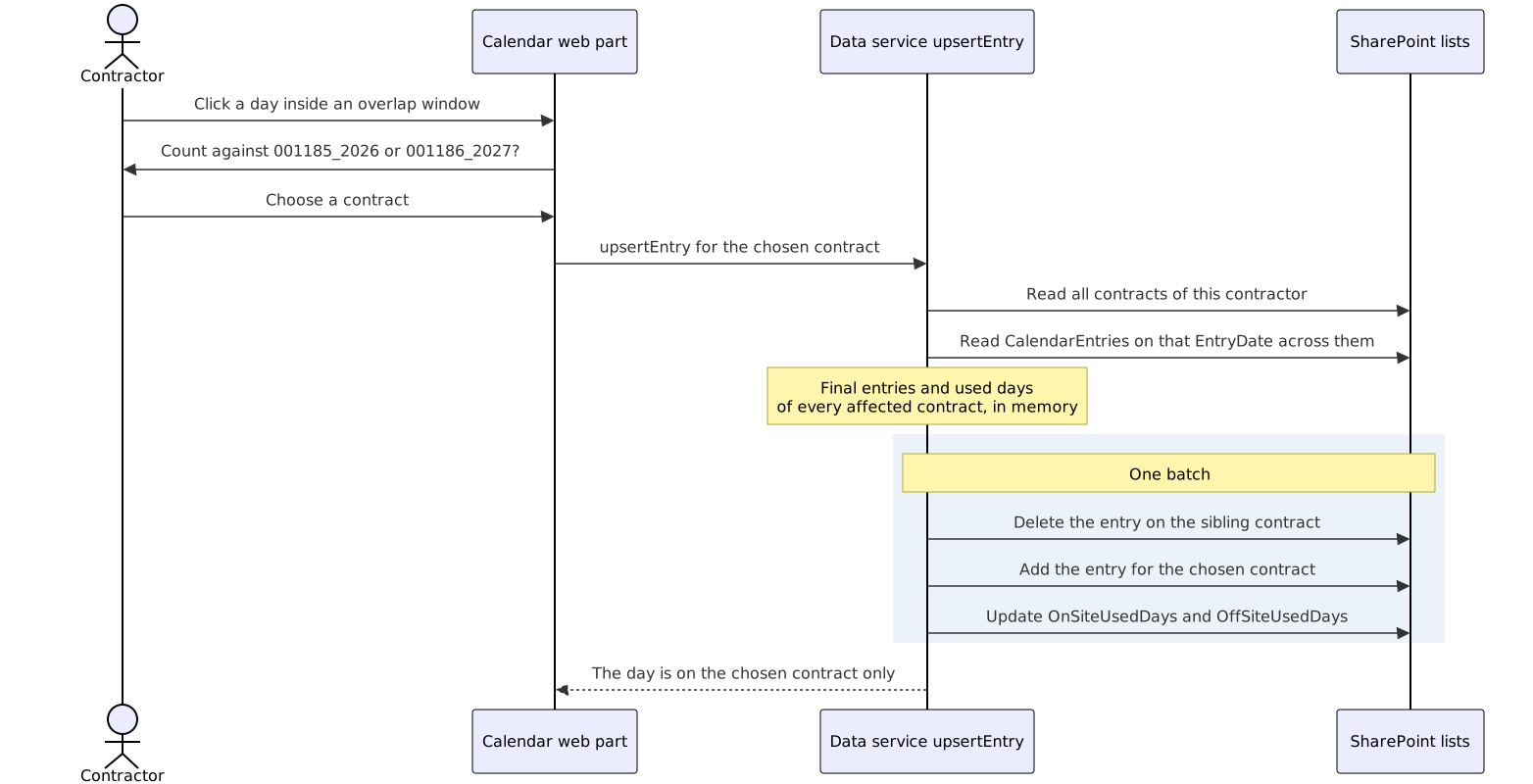
The data service enforces one CalendarEntries
row per contractor per EntryDate across all of that
contractor's contracts. When the contractor clicks a day inside
an overlap window the web part asks which contract the day counts
against ("Count against 001185_2026 or 001186_2027?"); choosing a
contract moves the day to it: in one batch the service
deletes the entry on the sibling contract, adds the entry on the chosen
one and updates the used days of both, so the day is never duplicated.
EntryDate and Contract are indexed;
Title is
<ContractCode> <yyyy-MM-dd>.
sequenceDiagram
  actor C as Contractor
  participant WP as Calendar web part
  participant DS as Data service upsertEntry
  participant L as SharePoint lists
  C->>WP: Click a day inside an overlap window
  WP->>C: Count against 001185_2026 or 001186_2027?
  C->>WP: Choose a contract
  WP->>DS: upsertEntry for the chosen contract
  DS->>L: Read all contracts of this contractor
  DS->>L: Read CalendarEntries on that EntryDate across them
  Note over DS: Final entries and used days<br/>of every affected contract, in memory
  rect rgb(235, 242, 250)
    Note over DS,L: One batch
    DS->>L: Delete the entry on the sibling contract
    DS->>L: Add the entry for the chosen contract
    DS->>L: Update OnSiteUsedDays and OffSiteUsedDays
  end
  DS-->>WP: The day is on the chosen contract only
Considered Options
| Option | Summary | Pros | Cons |
|---|---|---|---|
| ✅ Service-enforced uniqueness, move on overlap | Invariant in IDataService; UI dialog on overlap |
Works identically for Local and SharePoint; no platform feature needed; explicit user choice | Not enforced by SharePoint itself; a direct list edit can break it |
SharePoint unique-value column on EntryDate |
Platform enforcement | Native | Would be unique across all contractors, not per contractor; wrong scope |
| Allow duplicates, de-duplicate on report | Count later | Simple writes | Ambiguous data; stats panel and PDF would disagree with the list |
| Entry references the person, not the contract | Simpler model | Fewer joins | Cannot attribute days to a contract at all |
Consequences
Positive:
- Totals, remaining days and the PDF are unambiguous.
- Bridge contracts are a first-class, demonstrable scenario (fixtures include one).
Negative / Trade-offs:
- Direct edits through the list UI bypass the invariant (see ADR-005 hardening).
upsertEntrymust look across the contractor's contracts, not only the selected one.
Risks: | Risk ID | Description | Impact (E/H/M/L) | Mitigation | |---------|-------------|------------------|------------| | R-DATA-1 | Duplicate rows created outside the web part | M | Service de-duplicates on read as a safeguard; RM-2 hardening; optional later validation |
Amendments
2026-10-23 — The decision is unchanged; the write path is described as the code does it, and three guards were added:
- "Moves" is a delete of the sibling entry plus an add on the chosen contract, with the used days of both recomputed, all in one SharePoint batch.
- Risk R-AGT-1: a SharePoint batch is not
transactional. If the delete succeeds and the add fails, the day is left
empty on both contracts. The web part shows an error and the agent
reports the day as
failed; the user records it again. A fix (add first, or verify and restore) belongs inshared-core. - Writes from one
SharePointDataServicerun one at a time, so the used-days recompute of one write cannot miss a concurrent write's day. - A day held by a Closed sibling contract is not moved: the write is refused. Writes to a Closed contract, by anyone other than the contract's contractor, or to a contract without a period are refused too (both data services, so the web part and the agent behave alike).
Related
- Related ADRs: ADR-003, ADR-005
- Related requirements: FR-02
- Related documents: design §6.1, §6.2, §6.4; Phase B BR-1/BR-2; Phase C (data)
- TOGAF phase: C — Data Architecture
- Decision maker(s): Kiril Iliev (owner)
- Stakeholders: Contractors; contract managers; builder