12. Declarative agent with Entra SSO and on-behalf-of to SharePoint
12. Declarative agent with Entra SSO and on-behalf-of to SharePoint
Date: 2026-10-22
Status
Accepted
Problem
The MCP server (0011-custom-mcp-server-in-typescript.md)
needs a front end that users already have open, and it has to know who
is calling. The web part's model depends on the identity of the
signed-in user: deriveRoles decides contractor, manager or
admin from the user's SharePoint id, the role filters of ADR 0005 use
it, and SharePoint list permissions apply to that user. Whatever sits
between Copilot and SharePoint must carry that identity through, and the
SharePoint audit log must show the real person as the actor of each
change.
Decision
The front end is a declarative agent built with the
Microsoft 365 Agents Toolkit
(packages/agent-contract-calendar). Its only action is a
RemoteMCPServer plugin (plugin manifest v2.4) with dynamic
tool discovery, secured with Microsoft Entra SSO
(OAuthPluginVault auth reference).
The server:
- Validates the incoming bearer token itself (jose, RS256): signature
from the tenant's keys, issuer pinned to the tenant (v1
sts.windows.netand v2login.microsoftonline.comforms), audience equal to the server's Application ID URI or client id (v1 and v2 tokens differ). - Exchanges it on behalf of the user (msal-node) for
a delegated SharePoint token with
AllSites.Write. The provisioning app registration, which hasAllSites.FullControl, is not reused. - Calls SharePoint as that user.
deriveRolesand the role filters run unchanged; HR is added as membership of a SharePoint group (see0013-vendor-column-and-hr-group-for-the-agent.md). - On a consent or interaction error from the exchange returns HTTP 401
with
WWW-Authenticate: Bearer, so Copilot shows the sign-in prompt (Entra SSO). Other failures return 500.
The server never uses app-only access to SharePoint.
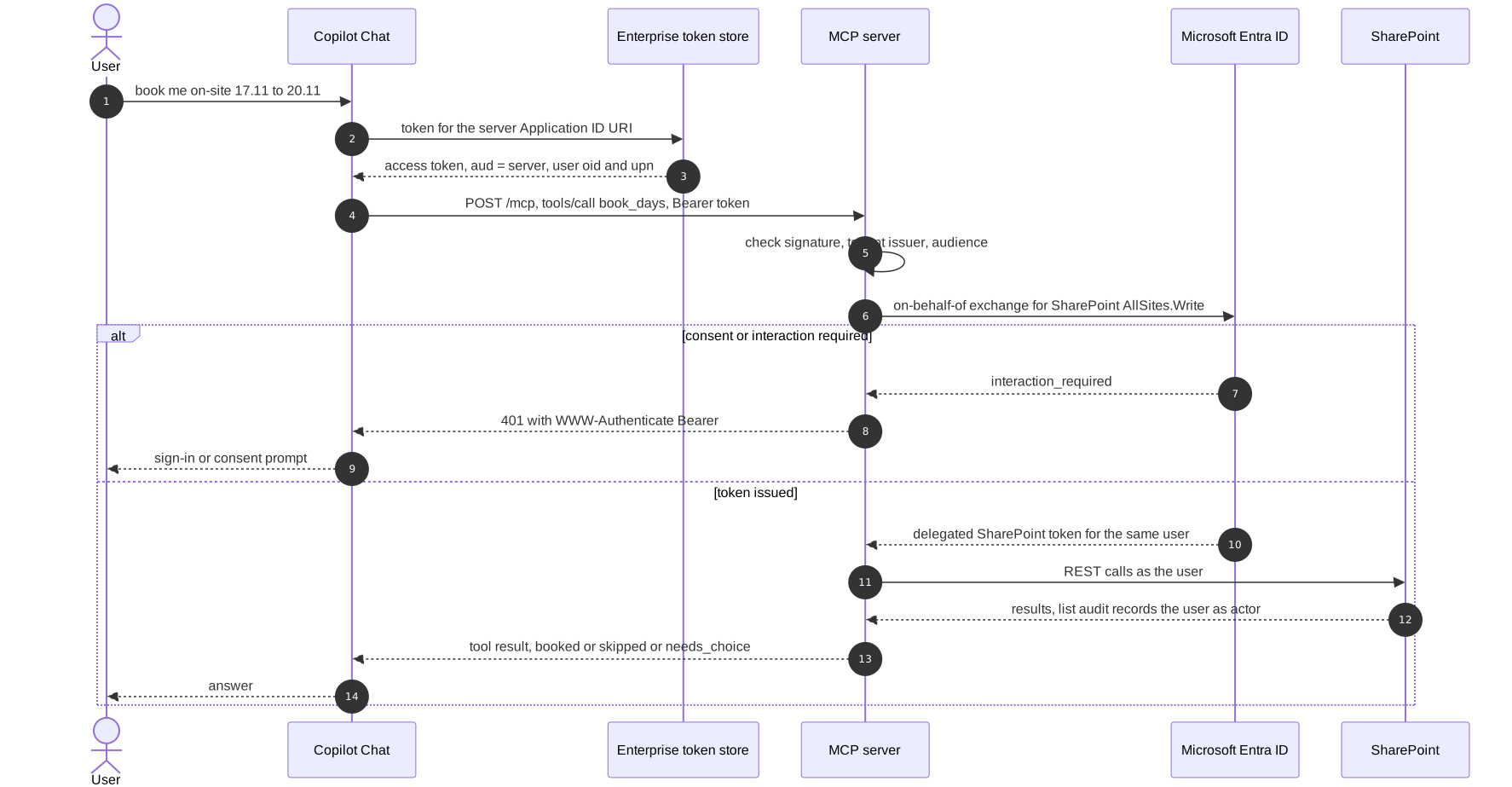
sequenceDiagram
  autonumber
  actor U as User
  participant C as Copilot Chat
  participant TS as Enterprise token store
  participant S as MCP server
  participant E as Microsoft Entra ID
  participant SP as SharePoint
  U->>C: book me on-site 17.11 to 20.11
  C->>TS: token for the server Application ID URI
  TS-->>C: access token, aud = server, user oid and upn
  C->>S: POST /mcp, tools/call book_days, Bearer token
  S->>S: check signature, tenant issuer, audience
  S->>E: on-behalf-of exchange for SharePoint AllSites.Write
  alt consent or interaction required
    E-->>S: interaction_required
    S-->>C: 401 with WWW-Authenticate Bearer
    C-->>U: sign-in or consent prompt
  else token issued
    E-->>S: delegated SharePoint token for the same user
    S->>SP: REST calls as the user
    SP-->>S: results, list audit records the user as actor
    S-->>C: tool result, booked or skipped or needs_choice
    C-->>U: answer
  end
Considered Options
Front end
| Option | Summary | Pros | Cons |
|---|---|---|---|
| ✅ Declarative agent, Agents Toolkit, MCP plugin | Manifest-only agent in Copilot Chat and Teams | Custom actions work in Copilot Chat without a Copilot licence (prerequisites); dynamic tool discovery; sideload from VS Code | Developer mode debug cards need a licensed user; the SharePoint page placement waits for the Agent Chat web part |
| Copilot Studio agent | Low-code agent with connectors | SharePoint channel exists | Rules re-implemented in flows; per-message billing |
| Custom engine agent (Agents SDK, own orchestration) | Full control of the model loop | Any model, any UI | We would own orchestration, safety and hosting of the bot; far more than six tools justify |
SharePoint .agent file |
Site-local Q&A agent | Simple | No actions; retires March 2027 |
Identity to SharePoint
| Option | Summary | Pros | Cons |
|---|---|---|---|
| ✅ Entra SSO to the server, on-behalf-of to SharePoint | Delegated token for the same user | SharePoint permissions and deriveRoles apply unchanged;
SharePoint audit shows the real user |
One app registration with exposed API, identifier URI, redirect URI, pre-authorised token store client; admin consent; a client secret or certificate for the exchange |
| App-only (certificate) to SharePoint | Server acts as itself | No consent prompts; simpler token handling | The server would have to re-implement who-may-see-what with full
site access; every SharePoint audit record would show
app@sharepoint instead of the person (audit
log activities); one leaked credential exposes every list |
| OAuth authorization code to a separate SharePoint app | User signs in to SharePoint through the plugin | Delegated | Copilot gets a SharePoint-audience token, so the server cannot validate a token meant for itself; mixes two audiences in one plugin |
No auth (None) |
Development only | Fast local loop | No user, so no roles; allowed only with DATA_MODE=local
and rejected by config otherwise |
The audit actor decides app-only. With on-behalf-of,
ListItemCreated / ListItemDeleted in Purview
name the contractor who asked; with app-only they name the app, and the
per-person trail has to be rebuilt from our own log alone.
Consequences
Positive:
- Visibility is the web part's: a contractor sees own contracts, a manager sees managed ones, HR and admins see all; a user with no role sees nothing.
- Writes by non-contractors are refused in the server
(
forbidden), not only by agent instructions. - Consent problems surface as a sign-in prompt instead of an opaque error.
Negative / Trade-offs:
- Owner steps in Entra: identifier URI,
oAuthConsentRedirectredirect URI, pre-authorised Enterprise token store client, admin consent forAllSites.Write(packages/agent-contract-calendar/README.md). - The OBO exchange needs a client secret locally; Key Vault and a certificate in the Azure target.
- The contractor Contribute-on-Contracts gap from ADR 0005 is unchanged: SharePoint would let a contractor edit a contract; the server, like the web part, is what stops it.
Risks: | Risk ID | Description | Impact (E/H/M/L) |
Mitigation | |---------|-------------|------------------|------------| |
R-AGT-4 | Production contractors are guest users; guest access to
declarative agents and Copilot Chat is not confirmed | H | Verify before
promising the channel to contractors (spec section 9, open item 1) | |
R-AGT-5 | Manifest schema versions (DA 1.8, app manifest 1.30, plugin
2.4, m365agents.yml 1.9) were written from documentation,
not from a scaffolded project | M | Compare with a freshly scaffolded
"Start with an MCP server" project at first provision | | R-AGT-6 | With
dynamic discovery the plugin manifest no longer carries per-function
confirmation hints for write tools | M | Agent instructions require one
confirmation before book_days and remove_days;
the server sets MCP tool annotations (readOnlyHint on
reads, destructiveHint: false on book_days,
destructiveHint: true on remove_days), which
Copilot reads to decide confirmations |
Related
- Related ADRs: ADR 0003, ADR 0005,
0011-custom-mcp-server-in-typescript.md,0014-three-layer-audit-for-agent-actions.md,0015-dev-tunnel-for-the-agent-demo.md,0017-sharepoint-placement-waits-for-agent-chat-web-part.md(why the agent is not in the SharePoint side pane) - Related documents: the contract agent design document of 2026-10-22
(not published) (sections 4, 5 "Identity"),
docs/research/2026-10-22-sharepoint-contract-agent.md("Identity and permissions", decisions D3 and D4),packages/agent-contract-calendar/README.md - Sources: Build MCP plugins, Entra SSO for plugins, Dynamic tool discovery, Declarative agents overview
- TOGAF phase: C — Application Architecture (security model); D — Technology Architecture (Entra)
- Decision maker(s): owner
- Stakeholders: contractors; contract managers; HR; tenant administrators; builder